Updated on October 28, 2026
Most businesses keep security footage for 30 to 90 days. Retail stores and offices usually sit at the short end, banks and regulated industries at the long end, and anything tied to an incident gets pulled out of the rotation and kept until the matter is closed. There is no single federal rule for private businesses; the period is set by a mix of state law, industry regulators, insurers and the practical limit of how much video the system can store before it overwrites itself.
Mobile Video Guard is a Bowie, Maryland security company that rents live-monitored mobile surveillance units to construction sites, yards and commercial properties in all 50 states. Our operators watch sites live, and incident video is clipped and shared with clients and police on request. This guide covers what retention periods look like across industries, what the law actually requires, and how to make sure the footage you need is still there when you need it.
Typical retention periods by business type
These are the norms we see in practice. Where a regulator sets a minimum, it is noted; otherwise the figure is what insurers, auditors and investigators generally expect.
| Business type | Typical retention | What drives it |
|---|---|---|
| Retail stores and restaurants | 30 to 90 days | Shrink investigations, slip-and-fall claims, chargeback disputes |
| Grocery stores and supermarkets | 30 to 60 days; longer at self-checkout and cash areas | High incident volume, slip-and-fall claims, organized retail theft cases |
| Offices and commercial buildings | 30 to 60 days | Access disputes, theft, insurance |
| Construction sites | 30 days rolling; incidents kept until the claim closes | Equipment theft, worker injury claims, contractor disputes |
| Warehouses and logistics yards | 30 to 90 days | Cargo claims, chain-of-custody questions, OSHA incidents |
| Banks and credit unions | 6 months or longer | Fraud investigations that surface months after the transaction; the Bank Protection Act requires cameras but sets no retention period, so banks set long ones |
| Casinos | State gaming minimums, commonly 7 to 30 days depending on the area covered | Gaming regulators |
| Cannabis dispensaries and grows | State-set minimums, for example 90 days in California and Illinois, 40 days in Colorado, 30 days in Michigan | State cannabis regulators audit retention directly |
| Hospitals and clinics | 30 to 90 days | Patient safety incidents, drug diversion, HIPAA access controls on who can view footage |
| Schools and universities | 30 to 90 days; longer where state education rules apply | Incident review, Title IX matters |
| Multifamily and HOA common areas | 30 days | Resident disputes, vehicle break-ins, package theft |
The pattern is simple: the longer it takes for a problem to surface, the longer the footage needs to survive. A shoplifting incident is known the same day. A fraudulent check can take months. A worker’s compensation claim can arrive a year after the fall.
What the law requires
For most private businesses in the United States there is no statute that says how long to keep security video. The requirements that do exist come from specific regulators:
- Cannabis. Every legal state sets a minimum retention period and inspects for it. This is the one industry where a short retention period is a licensing violation.
- Gaming. State gaming commissions set minimums for surveillance of tables, cages and count rooms.
- Banking. Federal rules require surveillance and the preservation of records relating to robberies, but leave the general retention period to the institution.
- Healthcare. HIPAA does not set a retention period for video, but it does govern who may view footage that shows patients.
- Litigation holds. Once a business knows that an incident may lead to a claim or lawsuit, it has a duty to preserve relevant evidence. Letting the system overwrite footage after that point can be treated as destruction of evidence. This applies in every state and is the rule that catches most businesses out.
Some states also have rules about notice and audio. Recording audio without consent is restricted in roughly a dozen states, and several require signs where cameras are in use. Those rules affect what you can record, not how long you keep it.
Why footage disappears sooner than you expect
Most systems record on a loop and overwrite the oldest video when storage fills. The retention period you actually get depends on how many cameras you have, the resolution and frame rate, and whether the system records continuously or only on motion. A 16-camera system recording continuously at full resolution can fill a recorder in under two weeks; the same system set to motion-only recording may stretch to two months. Many businesses believe they have 30 days of footage and find they have nine.
The practical rule: when something happens, export the clip the same day. Do not rely on the system still holding it when the insurer, the police or the lawyer asks for it three weeks later.
On-site, cloud or both
Recording to an on-site recorder is cheap and keeps the footage under your control, but it is vulnerable to theft of the recorder itself, which is common in break-ins, and to fire or flood. Cloud recording survives all of that and makes retention a line item you choose rather than a limit the hardware imposes. The trade-off is bandwidth and a monthly fee per camera. Many businesses keep a short rolling period on site and send event clips to the cloud for the long term.
For temporary sites such as construction projects, equipment yards and events, the question is usually answered by the monitoring provider. Mobile Video Guard units record continuously on the unit and our operators clip incident video as it happens, so the footage that matters is saved the moment it is needed rather than fished out of a recorder later.
A retention policy that holds up
- Write down the period for each camera group and the reason for it. Thirty days for the parking lot, ninety for the cash office, and so on.
- Check the system actually delivers that period. Look at the oldest footage available today.
- Name who can export footage and log every export.
- Put a litigation hold step in the incident procedure: when an incident is reported, the clip is exported and the retention clock stops for it.
- Review the policy when you add cameras, change resolution or change insurers.
Frequently asked questions
How long do most businesses keep security camera footage?
Thirty to ninety days is the norm. Regulated industries such as banking, gaming and cannabis keep footage longer or are told exactly how long by their regulator.
Is there a federal law on security footage retention?
Not a general one. Federal rules touch banks and some federal facilities; everything else is state law, industry regulation, insurance requirements and the duty to preserve evidence once a claim is foreseeable.
What retention period is recommended for construction video evidence?
A 30-day rolling window is standard for routine footage. Anything tied to an incident, a theft, an injury, a delivery dispute or a contractor claim, should be exported and kept until the matter is closed, which for an injury claim can mean years. Live-monitored sites have an advantage here because the operator clips the incident while it is happening.
Can I delete footage after an incident?
Not once you know the incident may lead to a claim. Export it and keep it. Deleting or letting it overwrite after that point can be treated as destroying evidence.
How do I get footage from a Mobile Video Guard unit?
Ask your account contact. Incident clips are prepared by the operator at the time of the event and shared on request, usually the same day, including to police working the case.
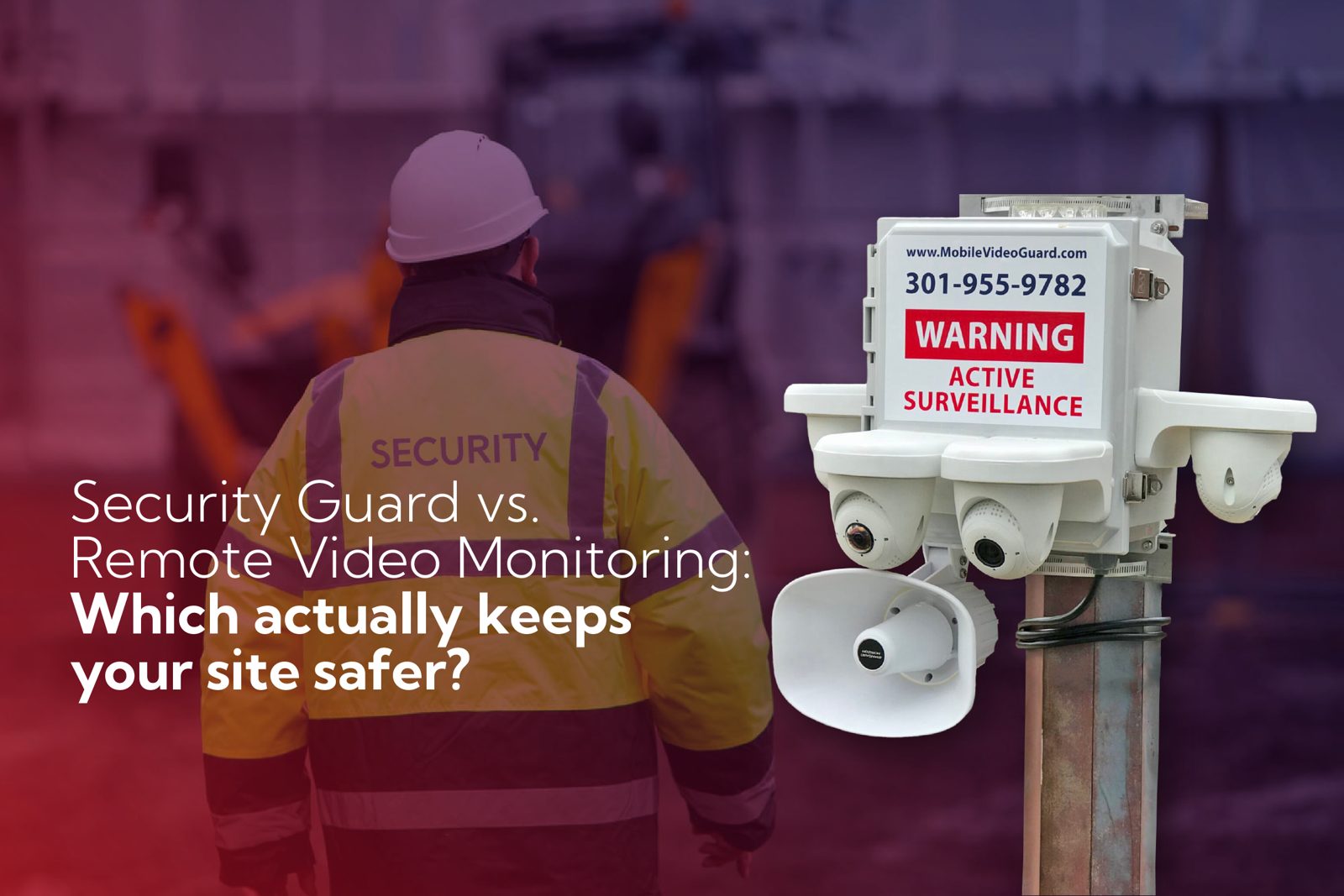
If you are weighing recorded cameras against live monitoring for a site, this comparison of guards and remote video monitoring covers what each actually delivers after hours. For a monitored unit on your own site, request a quote and we will come back the same business day.