Choosing between security guards and remote video monitoring for a construction site is a decision most contractors make based on familiarity rather than evidence. Guards are the default. They’re what everyone has always used, and the assumption that a physical presence equals strong security is deeply ingrained. The data tells a different story. This comparison looks at both options honestly — cost, coverage, response capability, and where each one makes sense — so you can make a decision based on what your site actually needs.
What Each Option Provides
A security guard provides a physical presence on site. They can walk the perimeter, check access points, respond directly to incidents, and call police when warranted. A well-trained guard on an active site is a genuine deterrent to opportunistic theft.
Remote video monitoring provides multi-camera coverage from elevated positions across the entire site, watched in real time by trained operators who can activate deterrents, speak directly to intruders via loudspeaker, and coordinate with law enforcement. The operators don’t take breaks, don’t get fatigued at 3am, and can monitor multiple zones simultaneously rather than being limited to wherever they happen to be standing.
The honest version of this comparison acknowledges that both options have real value. The question isn’t which one is good — it’s which one delivers the right protection for the cost, at the scale your site requires.
Cost: The Numbers Side by Side
According to an analysis by Elite Interactive Solutions comparing remote guarding and traditional security guard costs, full 24/7 guard coverage requires approximately 3.5 guard positions to cover all shifts with vacation, sick days, and turnover factored in. At current wage and benefits rates, that translates to annual costs between $330,000 and $450,000 per site for round-the-clock coverage.
Even overnight-only guard coverage — one guard for an 8-hour overnight shift — runs $6,000 to $8,000 per month depending on location and guard tier.
Remote video monitoring for a construction site typically costs between $1,500 and $5,000 per month depending on site size and the number of units required. That figure covers equipment, installation, monitoring, and maintenance. No overtime, no sick days, no workers’ compensation exposure, no management overhead.
Companies that switch from guard services to live video monitoring consistently report cost reductions of 60% to 90% over their previous security spend, while gaining wider camera coverage and active response capability. For contractors managing multiple concurrent projects, those savings multiply across the portfolio.
Coverage: One Person vs. Multiple Cameras
A security guard can only be in one place at a time. On any construction site larger than a small single-family build, that creates blind spots. The back fence line while the guard is at the front gate. The material staging area while the guard is checking equipment. The second access point while the guard is on the far side of the perimeter.
Professional thieves are aware of this. Organized theft rings case sites specifically to identify patrol patterns and locate the windows — often 15 to 20 minutes between patrol loops — when specific areas are unobserved. That’s enough time to load a truck.
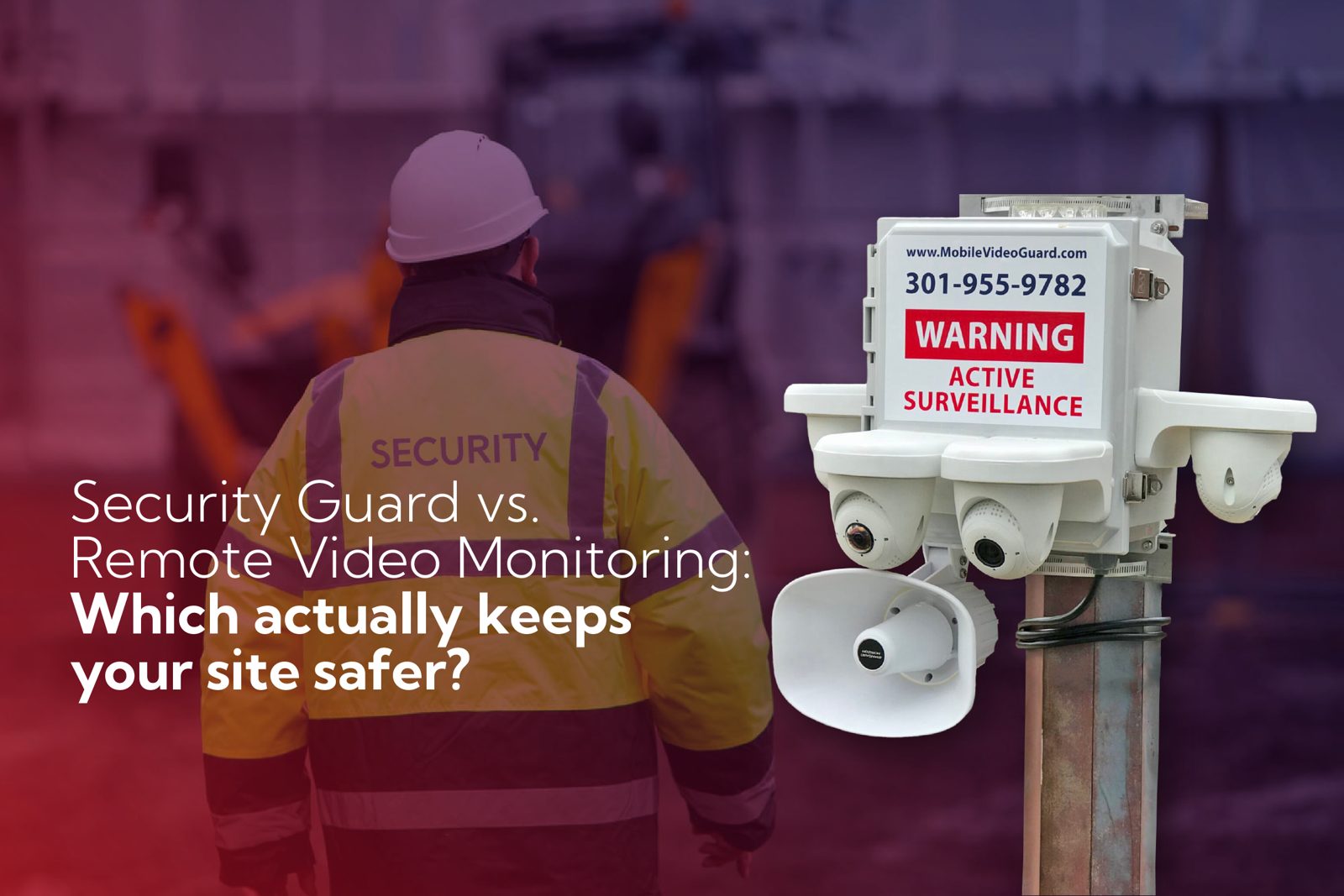
Remote video monitoring from Mobile Video Guard eliminates this structural limitation. Units mounted at 20 feet or higher provide up to four camera angles per unit, giving operators a 360-degree view of the site. Multiple units can cover any site size with no blind spots between patrol routes, because there are no patrol routes. The entire site is visible simultaneously.
AI-assisted analytics configured to detect people and vehicles rather than incidental movement mean the operator is alerted in real time when a perimeter is breached, not when they happen to be looking at that part of the feed.
Response Capability: What Happens When Something Goes Wrong
Here is where the comparison gets most meaningful. When a guard identifies a threat, they can confront it directly or call police. Their response is limited to their physical presence and communication device.
When a monitored operator identifies a threat, they have a sequence of immediate options: activate red and blue strobe lights visible across the site, use the built-in loudspeaker to speak directly to the person on site — describing what they’re wearing and what they’re doing — and place an emergency call to local law enforcement with live visual context.
The loudspeaker element is worth dwelling on. A person who hears a specific, detailed description of their own actions and appearance through a speaker at a dark construction site at 2am has a fundamentally different risk calculation than someone walking past a camera. The intervention happens before any theft occurs and without requiring anyone to physically be on site.
For reference on how sophisticated theft attempts actually work, the construction security audit guide covers perimeter vulnerabilities that professional thieves actively look for, which is useful context for understanding what both guards and monitoring are actually defending against.
Where Guards Still Make Sense
This comparison isn’t meant to suggest guards have no place on construction sites. There are situations where a physical presence is appropriate or required.
Sites with specific confrontational risk factors — active disputes with former employees, organized gang activity in the area, or sites that have been targeted multiple times in quick succession — may benefit from a guard presence during particularly high-risk windows, used alongside monitoring rather than instead of it.
Some contract requirements or insurance policies specify on-site security personnel. In those cases, the question becomes whether monitoring can reduce the number of guard hours required rather than replace guards entirely.
For most standard overnight construction site security, the data supports monitoring as the more effective and significantly cheaper option. But the two aren’t mutually exclusive. A guard during peak activity hours and monitored cameras from 6pm to 6am is a common hybrid model that gets the most from both.
Reliability and Consistency
Guard performance varies. A guard on their first shift at a new site is different from one who has been there for three months. Night shift fatigue affects performance. Turnover in the security industry is high, meaning the person protecting your site may change frequently without notice.
Remote monitoring provides consistent performance because it isn’t dependent on any individual’s attention level. The same cameras, the same alert thresholds, and the same operator protocols are in place every night. There’s no sick day that leaves coverage to chance.
Mobile Video Guard’s construction site security service operates without long-term contracts, meaning coverage can be adjusted as the project evolves, expanded to cover additional units as the site grows, and discontinued cleanly when the project wraps — all without the scheduling, HR, and administrative burden of managing a guard service.
Making the Right Call
The right answer depends on your site’s specific situation. A compact urban build with natural street-level visibility and a short timeline has different needs than a 10-acre rural development site with multiple access points and $500,000 of equipment on site.
What the data consistently shows is that for overnight construction site coverage, remote video monitoring delivers equivalent or superior deterrence at 60% to 90% lower cost than guard services, with no blind spots, no fatigue, and active intervention capability rather than passive patrol.
For a site-specific assessment, Mobile Video Guard provides proposals within a few hours of contact and can have a monitored system operational within 24 hours.
Frequently Asked Questions
Are security guards or remote video monitoring more effective for construction sites?
For overnight coverage of large or multi-access-point sites, remote video monitoring consistently outperforms single-guard coverage on cost, coverage area, and active deterrence capability. Guards provide value in specific confrontational or high-presence scenarios.
How much does construction site security monitoring cost compared to guards?
Security guards for overnight coverage typically cost $6,000 to $8,000+ per month. Live monitored surveillance typically costs $1,500 to $5,000 per month depending on site size, representing savings of 60% to 90%.
Can remote video monitoring replace security guards completely?
For most overnight construction site coverage, yes. In specific situations requiring physical presence or where contract terms specify on-site personnel, a hybrid approach using monitoring as the primary layer works well.
What makes remote video monitoring more reliable than a security guard overnight?
Monitoring systems don't experience fatigue, don't have patrol blind spots, and don't vary in performance night to night. The operator sees the entire site simultaneously and is alerted immediately when a perimeter is breached.
How quickly can remote construction site monitoring be deployed?
Professional services like Mobile Video Guard can have a fully operational monitored system in place within 24 hours of initial contact, with no long-term contract required.